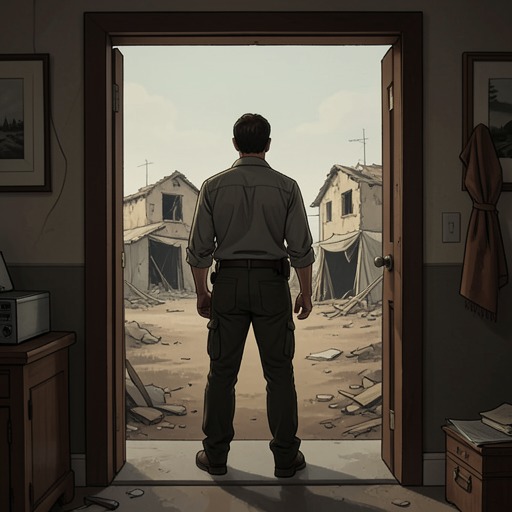
Escape and evasion
Journey to the End of the NightEscape and evasion names a recurring, unstable desire in the novel: to get away from the routines, relationships, and selves that have become intolerable. Baryton’s dramatic departure from his psychiatric institute gives that desire a concrete form, while the narrator’s later reflections on age and wandering expose its limit. Leaving can feel like rebirth, but distance alone does not guarantee freedom; the self one tries to abandon keeps reappearing along the road.
Baryton’s wish to break free
Baryton’s urge to escape grows out of his long entanglement with patients’ families. After twenty years of dealing with their quarrelsome vanity, he has developed a deep resentment toward the demands surrounding his work. He doubts that he can ever free himself from their hold or from the degrading servitudes of what he calls alimentary psychiatry. Routine, the narrator observes, has become a kind of death to Baryton’s ego: he no longer seeks a new method within the same life, but wants to take his body somewhere else.
That desire is not simply a passing complaint. The narrator retrospectively connects Baryton’s critical tirades and his longing for something utterly different to his growing readiness to flee. Baryton, who considers himself reasonable, finally breaks with his circumstances through a scandalous action. The account initially withholds what he has done, emphasizing instead that the assistant’s ordinary work continues while Baryton’s escape gathers force. The delayed disclosure makes departure feel less like a calm plan than a rupture already underway.
The declaration of departure
On the night he tells the narrator he is leaving the institute, Baryton presents the decision as a complete break with his past. He describes himself as a sedentary man on the brink of old age, with a career founded on long, scrupulous habits of verification, yet insists that within a few months he has turned away from everything that kept him there. He feels detached and exultant, calls the change a rebirth, and repeats that he is fleeing. His rhetoric makes escape sound at once like a physical departure and a remaking of identity.
The narrator tries to recast the journey as a temporary holiday: a diversion from professional routine after which Baryton might return refreshed and resume his place at the head of the institute. Baryton rejects the comforting interpretation. He says that forty years of prudent mediocrity have drained and defeated him, and that he wants to lose his soul as one might lose a repellent dog, get away from it before death, and at last be alone and at peace. His stated objective is not merely a change of workplace. He wants distance from the self and past that his life has made unbearable.
Baryton’s own language also registers the cost of that resolve. He admits that he is torn and bleeding, but insists he would not turn back even if he had left an eye behind in the mire. The image gives departure a bodily price: escape is not presented as a painless exit, and the willingness to abandon what has been lost becomes part of its force. The narrator does not doubt Baryton’s sincerity, and refrains from pressing him with contradiction, fearing that it could damage his reason.
The narrator at the edge of escape
The narrator’s work beside patients brings a different danger into view. Because he is kind to the inmates, he feels himself living on the rim of their madness, as if ordinary conversation were leading him into an unfamiliar city whose streets and ground grow unstable. He worries that he may be trapped there with them, and that recovering his reason could become an obsession in itself. Escape in this passage is not only a journey away from an institution; it is also the uncertain effort to preserve one’s footing and identity while remaining close to other people’s distress.
Later, the narrator recognizes a resemblance between his own growing indifference and Baryton’s withdrawal. When Robinson tells him about his adventure in Toulouse, the narrator cannot summon much interest or treat the situation as a genuine danger. He feels that he has aged suddenly and reflects that the world leaves people before they leave it. The change is marked less by one dramatic decision than by diminishing speech and desire: it becomes an effort to talk about what matters, to insist on being right, or even to keep one’s allotted place among life’s pleasures.
Wandering and its limit
The narrator describes the late stage of this withdrawal in deliberately small terms. A person becomes content with a little food, a little warmth, and as much sleep as possible while moving along a road to nowhere. Even the social self seems exhausted: inventing new performances for others would require a strength that is gone. Death, he says, is present beside the wanderer, no longer mysterious but constantly near. What remains vivid is a petty regret: failing to visit an uncle at Bois-Colombes while he was still alive, and losing forever the uncle’s little song. The scale of that regret contrasts with grand schemes of escape; the life left behind persists through an ordinary missed visit and its irretrievable consequence.
At the novel’s close, the narrator turns away from the river and from the sea that once carried the promise of elsewhere. He says that there is no room left in him for imaginings about the sea, that he has tried to lose himself but keeps finding his own life, and that his wanderings are over. The world has closed in. Physical movement, once a way to avoid facing himself, has brought him back to himself instead.
His final comparison with Robinson sharpens the difference between a wish to escape and an idea powerful enough to organize a life. The narrator imagines Robinson’s intention to get himself killed as a single, forceful idea that could overcome fear, while his own thoughts remain like faint candles trembling in a hostile universe. He even fantasizes about a courage so complete that it would enfold death in love, but recognizes the extravagant image as feverish imagining. Escape remains compelling precisely because it promises a total transformation; the ending refuses to treat that promise as fulfilled. The narrator’s return to himself makes wandering’s limit, rather than departure’s triumph, the concept’s decisive conclusion.